
What You Should Know Before Planting a Shade Garden
Create beauty beneath the canopy inspired by this Washington forest retreat.
Nic Lehoux
Shade gardens often get a bad rap. Too dark, too damp, too difficult. But in the Pacific Northwest, they’re where magic happens. Beneath the canopy of Douglas firs and red cedars, filtered light turns leaves into lanterns, moss softens every surface, and design becomes less about control and more about harmony.
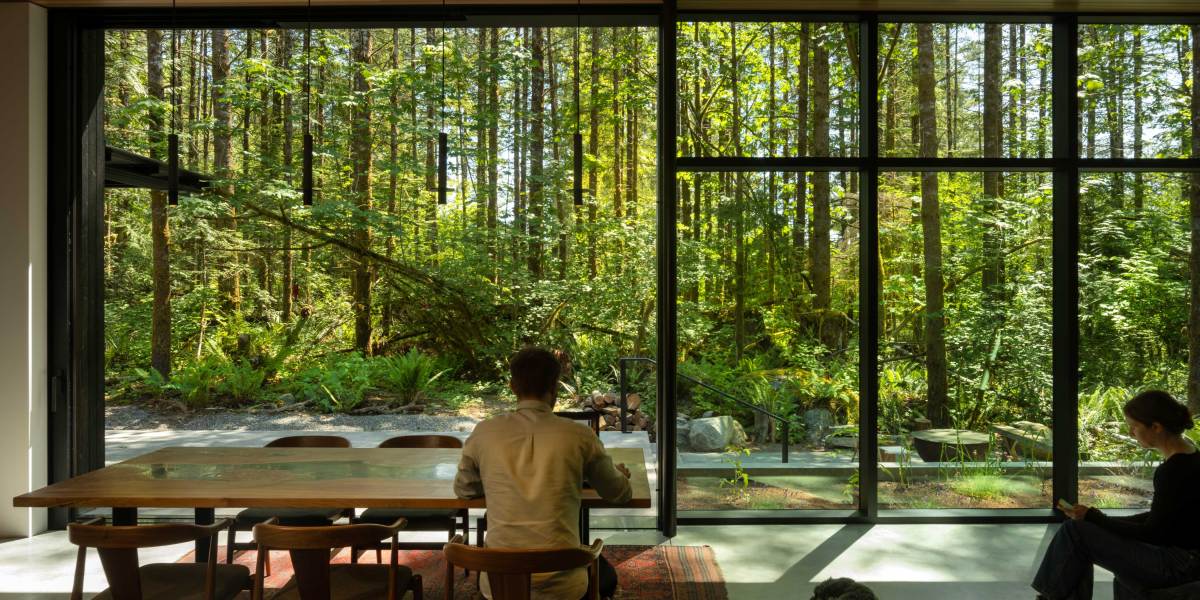
That sense of partnership with nature is what guided Mark Johnson, AIA, Founding Principal at Signal Architecture + Research, when his team designed the project aptly named Forest Pavilion, a North Bend, Washington, home tucked into a second-growth forest. Working with the land instead of clearing it, the design preserves tree roots, celebrates rainfall, and folds human life seamlessly into the ecosystem. The result is a house and landscape that feel born of the same forest floor—where sword ferns, salal, and huckleberries thrive under the filtered glow of native evergreens.
“We approach projects with a deep reverence for found conditions, and we evaluate greenfield, undeveloped sites with nature as a guide,” Johnson says. “The home is sited around the contours of knolls and hollows, slipping between trunks rather than displacing them.”
Here, Johnson shares how thoughtful design and planting choices can transform even the darkest corners of a landscape into thriving, beautiful spaces.
Design in Conversation with Nature
Nic Lehoux
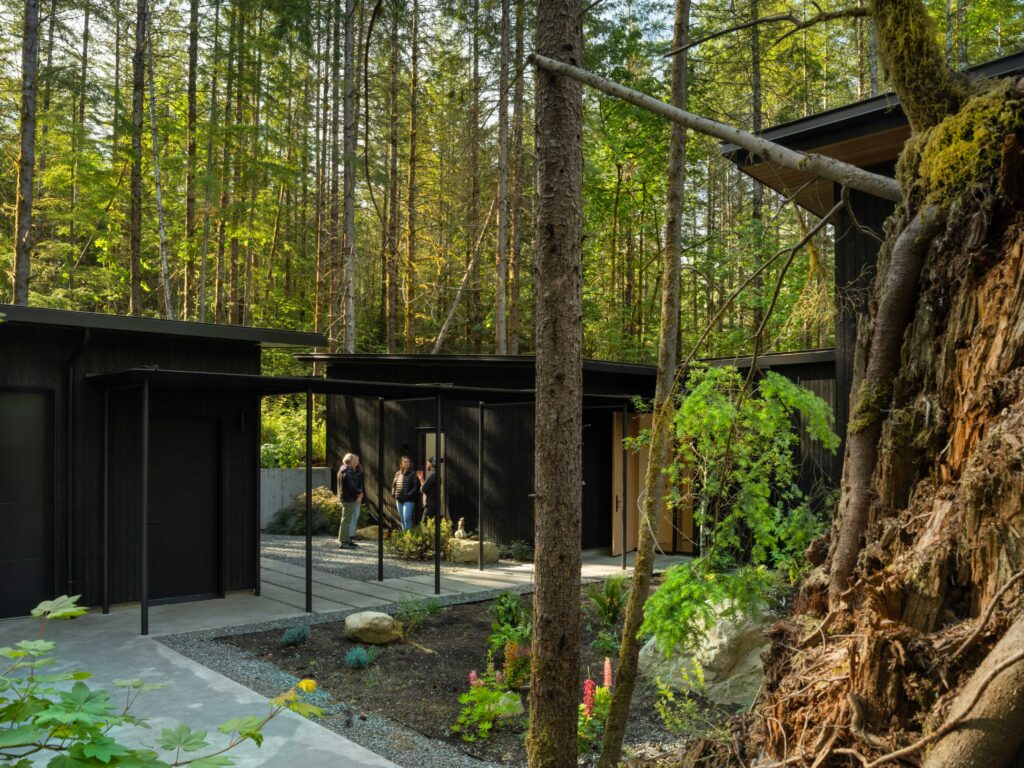
Every decision at Forest Pavilion began with listening to the land. “Nature, the land, has a voice and an identity. Natural systems can have both technical and ephemeral influences on a design approach,” Johnson explains. “Orienting the building to catch rising sun while sheltering from afternoon heat, shielding entrances from prevailing winds and snow drifts, celebrating rainfall. All have technical outcomes while welcoming site-specific design elements that only occur in the home.”
Inside, the experience is equally immersive. “The guiding principle, set by the homeowners, was to ‘feel like we are in the woods at all times,’” Johnson notes. “You can see, feel, and hear the forest from everywhere in the home: light dappled through fir boughs, a single floor level that matches the exterior grade, seeing the seasons through selective walls of glass, and hearing the wind in the branches.”
Even the materials tell a story of resilience. “Scale is one of the most important factors to discuss. Building the right thing, within the carrying capacity of the land, to the highest quality, will serve you for the long term and the life of the structure,” Johnson says. FSC wood, local sourcing, and energy-efficient systems are all part of creating a home that lasts for generations.
The Forest as Blueprint

Nic Lehoux
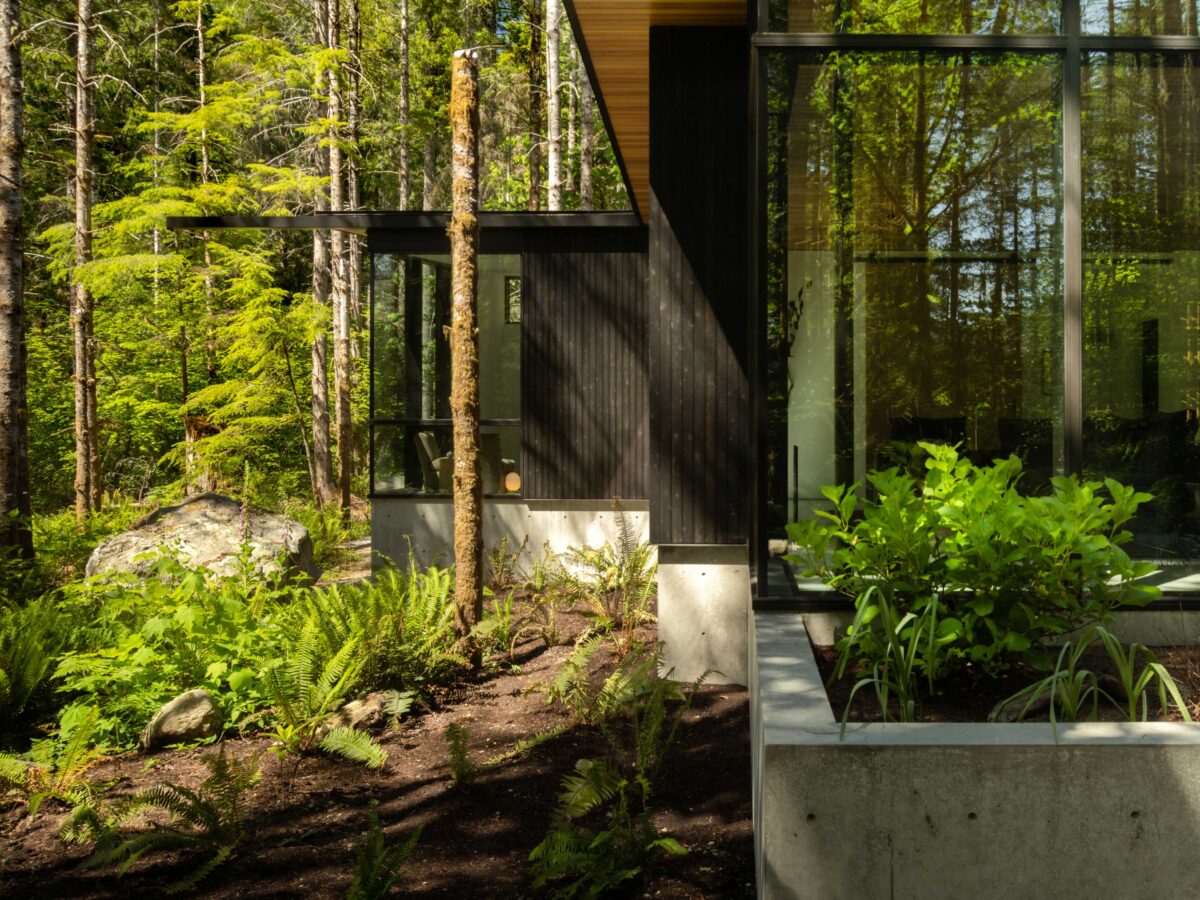
Instead of starting with an ornamental plant list, Johnson looked to what was already thriving. “Existing species on the site were the ultimate guide for plant choices,” he says. “Repair of the areas disturbed by construction was largely managed with ferns (Polystichum munitum, Blechnum spicant, Adiantum aleuticum) and salal (Gaultheria shallon) harvested from the site.”
Even ornamental choices echo the forest’s natural rhythm. “Japanese maples thrive, and rhododendrons and vine maples grow with more open branches, reaching for the light, creating very architectural branching structures,” Johnson explains.
For gardeners across the West, this approach translates beautifully: Begin by observing, then plant what belongs. “Options for similarly shady sites might include select placement of flowering and fall/spring color accents like Pacific dogwood, red osier dogwood, and red huckleberry. Using the USDA Plant Hardiness Zone Map to understand your microclimate is critical,” Johnson advises.
Plant Pairings to Echo the Forest
- Ground layer: sword fern (Polystichum munitum) + deer fern (Blechnum spicant) for texture and movement
- Mid layer: salal (Gaultheria shallon) + evergreen huckleberry (Vaccinium ovatum) for glossy leaves and edible berries
- Accent layer: vine maple (Acer circinatum) + Japanese maple (Acer palmatum) for sculptural structure and fall color
- Moss & filler: Oregon beak moss (Kindbergia oregana) + stair-step moss (Hylocomium splendens) to soften stone and wood edges
Understory Wisdom: How to Plant Beneath Trees
Nic Lehoux
Planting under mature trees requires finesse and patience. “Considering the long-term health of the forest is a critical first step. Arborist analysis and consultation with them to describe the vision and hear their interpretation of the expected stresses on the trees and mitigation planning is critical,” Johnson says.
Even construction required care. “Paths into the site were well considered prior to construction to reduce unnecessary disturbance beyond the home footprint. Limiting work outside driplines increases survivability of the existing trees, reducing stress from compaction,” he notes.
For home gardeners, the same rule applies: Go light on the land. “Starting small, with plugs or small plants, will both increase survivability of new plants and reduce stress on existing vegetation. Organic mulch helps retain moisture, and spot watering of new plants ensures trees aren’t overwatered,” Johnson recommends.
And perhaps the most relatable advice: “Trees usually win the competition for water and nutrients, so new understory plantings need extra water in the first years. Instead, plant small perennials, groundcovers, or shrubs in pockets between roots and dig carefully.”
Living with, Not Against, the Elements
Nic Lehoux
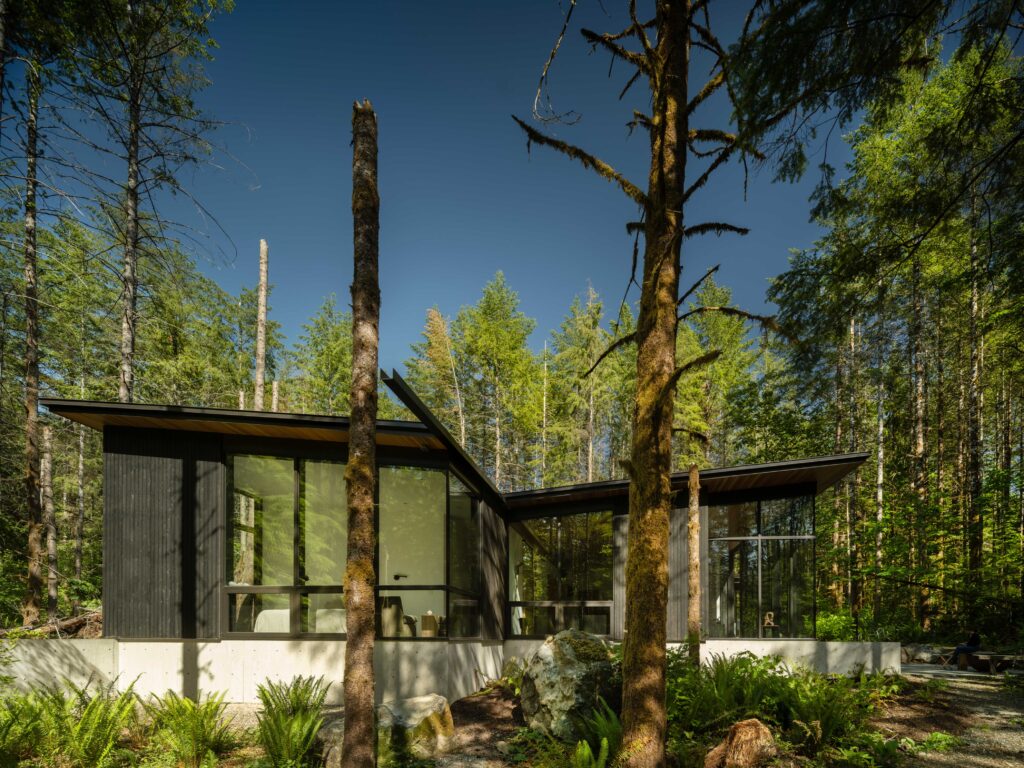
In the Pacific Northwest, resilience is both an architectural and horticultural value. “Locating the primary entrance downwind from the prevailing winter winds, amply covering doors and openings with canopies, and welcoming the landscape to do what it already knows how to do are critical to the resilience of this place,” Johnson explains.
Rain isn’t a nuisance here, it’s sculpture. “Rainwater is welcomed rather than resisted; directed off the butterfly roof into heavy gutters that pour onto mossy stones, freezing into ice sculptures in the winter,” he says.
The home’s relationship with its setting runs deep, literally. “When the concrete floors were poured, the surface hadn’t even set before the forest began to reclaim it. Pine needles drifted in on the breeze and pressed into the tacky surface, becoming permanent fossils within the interior,” Johnson recalls.
Lessons for Western Gardeners

Nic Lehoux
“Shade gardens and native landscapes act as quiet infrastructure,” Johnson notes. “They stitch together fragmented ecosystems, buffer against heat and drought, and offer beauty that is functional rather than purely ornamental.”
For gardeners across the Western states, that’s an empowering message: Shade isn’t something to work around, it’s something to design with. Forest Pavilion shows that shade doesn’t have to be a limitation. Instead of clearing trees to make space for sun, the home tucks into their cover. The result is cooler spaces in summer, less water demand for the garden, and a landscape that feels cohesive with its surroundings.