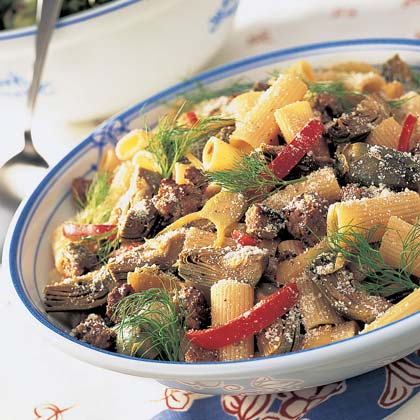

James Carrier
Notes: To be completely edible, small artichokes must be peeled down to tender leaves that are pale green to the tip. Save fennel leaves to garnish pasta.
Break off and discard artichoke leaves down to the pale green, tender inner leaves. Cut off and discard thorny tips. Trim bottoms. Quarter artichokes (they will discolor). Trim out and discard fuzzy centers. Rinse and drain artichokes.
Trim and discard stems and any bruised portions from fennel. Rinse fennel and thinly slice crosswise.
In a 5- to 6-quart pan over medium-high heat, frequently stir sausages, breaking up meat with spoon, until brown, about 10 minutes.
Add artichokes, fennel, onion, fennel seed, garlic, and bell pepper to pan. Stir often until onion is limp, about 10 minutes.
Pour wine, broth, and cream into pan. Bring to a boil over high heat, then reduce heat and simmer, stirring occasionally, until artichokes are tender when pierced, about 10 minutes.
Meanwhile, cook pasta in 4 quarts boiling water until tender to bite, 10 to 12 minutes.
Drain pasta, put in a serving bowl, and top with artichoke sauce.
Offer cheese and salt to add to taste.
0 servings
* The % Daily Value (DV) tells you how much a nutrient in a serving of food contributes to a daily diet. 2,000 calories a day is used for general nutrition advice.