-
Find the right plant
The Sunset Plant Finder helps you choose the right flowers and plants for your climate and gardening style
more
-
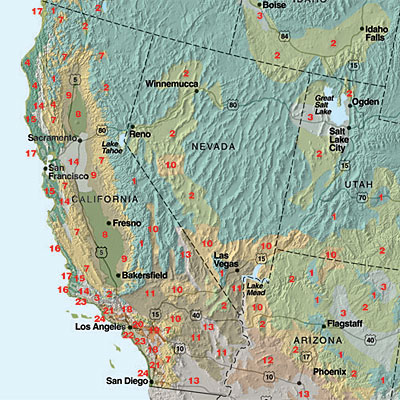
Learn about your climate zone
- Alaska
- Hawaii
- Western Washington
- Western Oregon
- Eastern Washington, Eastern Oregon, and Idaho
- Northern California
- San Francisco Bay Area and inland
- Central California
- Los Angeles region
- San Diego region
- Southern California desert
- New Mexico
- Arizona
- Nevada, Wyoming, Utah, Colorado
- Central Plains
- Texas
- Great Lakes
- Northeast
- Mid-Atlantic
- Southeast
- Gulf Coast/South
Note: For a more detailed map, go to the Sunset Plant Finder and click on the "Find your zone" link.
ZONE 1. Coldest Winters in the West and Western Prairie States
Growing season: early June through Aug., but with some variation―the longest seasons are usually found near this zone's large
bodies of water. Frost can come any night of the year. Winters are snowy and intensely cold, due to latitude, elevation, and/or
influence of continental air mass. There's some summer rainfall.
ZONE 2. Second-coldest Western Climate
Growing season: early May through Sept. Winters are cold (lows run from -3 degrees to -34 degrees F/-19 degrees to -37 degrees
C), but less so than in Zone 1. In northern and interior areas, lower elevations fall into Zone 2, higher areas into Zone
1.
ZONE 3. West's Mildest High-elevation and Interior Regions
Growing season: early May to late Sept.--shorter than in Zone 2, but offset by milder winters (lows from 13 degrees to -24
degrees F/-11 degrees to -31 degrees C). This is fine territory for plants needing winter chill and dry, hot summers.
ZONE 7. Oregon's Rogue River Valley, California's High Foothills
Growing season: May to early Oct. Summers are hot and dry; typical winter lows run from 23 degrees to 9 degrees F/-5 degrees
to -13 degrees C. The summer-winter contrast suits plants that need dry, hot summers and moist, only moderately cold winters.
ZONE 8. Cold-air Basins of California's Central Valley
Growing season: mid-Feb. through Nov. This is a valley floor with no maritime influence. Summers are hot; winter lows range
from 29 degrees to 13 degrees F/-2 degrees to -11 degrees C. Rain comes in the cooler months, covering just the early part
of the growing season.
ZONE 9. Thermal Belts of California's Central Valley
Growing season: late Feb. through Dec. Zone 9 is located in the higher elevations around Zone 8, but its summers are just
as hot; its winter lows are slightly higher (temperatures range from 28 degrees to 18 degrees F/-2 degrees to -8 degrees C).
Rainfall pattern is the same as in Zone 8.
ZONE 10. High Desert Areas of Arizona, New Mexico, West Texas, Oklahoma Panhandle, and Southwest Kansas
Growing season: April to early Nov. Chilly (even snow-dusted) weather rules from late Nov. through Feb., with lows from 31
degrees to 24 degrees F/-1 degree to -4 degrees C. Rain comes in summer as well as in the cooler seasons.
ZONE 11. Medium to High Desert of California and Southern Nevada
Growing season: early April to late Oct. Summers are sizzling, with 110 days above 90 degrees F/32 degrees C. Balancing this
is a 3 1/2-month winter, with 85 nights below freezing and lows from 11 degrees to 0 degrees F/-12 degrees to -18 degrees
C. Scant rainfall comes in winter.
ZONE 12. Arizona's Intermediate Desert
Growing season: mid-Mar. to late Nov., with scorching midsummer heat. Compared to Zone 13, this region has harder frosts;
record low is 6 degrees F/-14 degrees C. Rains come in summer and winter.
ZONE 13. Low or Subtropical Desert
Growing season: mid-Feb. through Nov., interrupted by nearly 3 months of incandescent, growth-stopping summer heat. Most
frosts are light (record lows run from 19 degrees to 13 degrees F/-17 degrees to -11 degrees C); scant rain comes in summer
and winter.
ZONE 14. Inland Northern and Central California with Some Ocean Influence
Growing season: early Mar. to mid-Nov., with rain coming in the remaining months. Periodic intrusions of marine air temper
summer heat and winter cold (lows run from 26 degrees to 16 degrees F/-3 degrees to -9 degrees C). Mediterranean-climate plants
are at home here.
ZONE 15. Northern and Central California's Chilly-winter Coast-influenced Areas
Growing season: Mar. to Dec. Rain comes from fall through winter. Typical winter lows range from 28 degrees to 21 degrees
F/-2 degrees to -6 degrees C. Maritime air influences the zone much of the time, giving it cooler, moister summers than Zone
14.
ZONE 16. Northern and Central California Coast Range Thermal Belts
Growing season: late Feb. to late Nov. With cold air draining to lower elevations, winter lows typically run from 32 degrees
to 19 degrees F/0 degrees to -7 degrees C. Like Zone 15, this region is dominated by maritime air, but its winters are milder
on average.
ZONE 17. Oceanside Northern and Central California and Southernmost Oregon
Growing season: late Feb. to early Dec. Coolness and fog are hallmarks; summer highs seldom top 75 degrees F/24 degrees C,
while winter lows run from 36 degrees to 23 degrees F/2 degrees to -5 degrees C. Heat-loving plants disappoint or dwindle
here.
ZONE 18. Hilltops and Valley Floors of Interior Southern California
Growing season: mid-Mar. through late Nov. Summers are hot and dry; rain comes in winter, when lows reach 28 degrees to 10
degrees F/-2 degrees to -12 degrees C. Plants from the Mediterranean and Near Eastern regions thrive here.
ZONE 19. Thermal Belts around Southern California's Interior Valleys
Growing season: early Mar. through Nov. As in Zone 18, rainy winters and hot, dry summers are the norm―but here, winter lows
dip only to 27 degrees to 22 degrees F/-3 degrees to -6 degrees C, allowing some tender evergreen plants to grow outdoors
with protection.
ZONE 20. Hilltops and Valley Floors of Ocean-influenced Inland Southern California
Growing season: late Mar. to late Nov.--but fairly mild winters (lows of 28 degrees to 23 degrees F/-2 degrees to -5 degrees
C) allow gardening through much of the year. Cool and moist maritime influence alternates with hot, dry interior air.
ZONE 21. Thermal Belts around Southern California's Ocean-influenced Interior Valleys
Growing season: early Mar. to early Dec., with the same tradeoff of oceanic and interior influence as in Zone 20. During the
winter rainy season, lows range from 36 degrees to 23 degrees F/2 degrees to -5 degrees C―warmer than in Zone 20, since the
colder air drains to the valleys.
ZONE 22. Colder-winter Parts of Southern California's Coastal Region
Growing season: Mar. to early Dec. Winter lows seldom fall below 28 degrees F/-2 degrees C (records are around 21 degrees
F/-6 degrees C), though colder air sinks to this zone from Zone 23. Summers are warm; rain comes in winter. Climate here is
largely oceanic.
ZONE 23. Thermal Belts of Southern California's Coastal Region
Growing season: almost year-round (all but first half of Jan.). Rain comes in winter. Reliable ocean influence keeps summers
mild (except when hot Santa Ana winds come from inland), frosts negligible; 23 degrees F/-5 degrees C is the record low.
ZONE 24. Marine-dominated Southern California Coast
Growing season: all year, but periodic freezes have dramatic effects (record lows are 33 degrees to 20 degrees F/1 degree
to -7 degrees C). Climate here is oceanic (but warmer than oceanic Zone 17), with cool summers, mild winters. Subtropical
plants thrive.
PAGE:1
- Loading comments...